
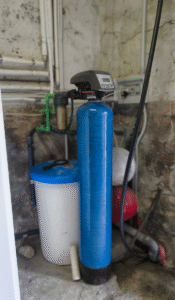
 The right water softener size depends on four things:
- Your water hardness level (measured in grains per gallon or GPG)
- The number of people in your household
- Your daily water usage
- If iron is present in the water.
There is no one-size-fits-all answer.
If the system is too small, you will run out of soft water and waste water and salt. If the system is too large, you can create inefficiency inside the tank and shorten the life of the resin beads.
In this guide, you will learn how to test your water hardness, calculate grains per day, use a water softener sizing chart, and determine the correct grain capacity for your home.
We will also cover what happens when you size softener equipment incorrectly and when professional water treatment makes more sense than guessing.
Quick Takeaways
- Water softener size is measured in grain capacity.
- Most homes need between 32,000 and 64,000 grains.
- Multiply: people × 75 gallons per day × hardness (GPG).
- Add extra capacity if iron is present.
- A properly sized water softening system should regenerate about once per week.
- Professional testing provides the most accurate sizing results.
How Water Softener Size Is Measured
Water softener size is based on grain capacity. Grain capacity tells you how many hardness grains the system can remove before it needs to regenerate.
One grain equals 1/7,000 of a pound of dissolved minerals, mainly calcium and magnesium. When we talk about grains per gallon (GPG), we are measuring how much hardness is present in each gallon of water.
Inside the tank, resin beads attract and hold calcium and magnesium. Once the beads become saturated, the system flushes them clean using salt. That cleaning process is called the regeneration cycle.
Bigger is not automatically better. A properly sized water softening system should regenerate about once every seven days. If it regenerates daily, it is too small. If it goes weeks without regenerating, it may be oversized.
Step 1: Test Your Water Hardness
Before you size softener equipment, you need your exact water hardness level in grains per gallon (GPG).
Understanding GPG
- 0–3 GPG: Soft
- 3–7 GPG: Moderately hard
- 7–10 GPG: Hard
- 10+ GPG: Very hard
Most homes with noticeable scale buildup test above 7 GPG.
How to Test
You have three options:
- City water report – Many municipal suppliers publish water hardness levels.
- DIY test kit – An inexpensive test kit can provide a quick reading at home.
- Professional test – A plumbing professional performs the most accurate analysis and checks for additional minerals.
Iron Adjustment Rule
If your water contains iron, adjust your hardness number upward.
Add 3–5 grains for every 1 ppm of iron.
Iron can overwhelm a small water softening system and clog resin beads faster than calcium alone. This is common in well water systems.
Step 2: Calculate Your Daily Water Usage
The industry standard estimate is simple:
Each person uses 75 gallons of water per day.
To estimate daily water usage:
Number of people × 75 gallons = daily water use
For example:
4 people × 75 gallons = 300 gallons per day
Adjust this number if:
- You have large soaking tubs
- You run multiple showers daily
- You have a large family
- You use high-efficiency fixtures that reduce water use
Daily water usage drives how many grains per day your system must remove.
Step 3: Calculate Your Required Grain Capacity
Water Softener Size Formula
(Number of people × 75 gallons per day × Water hardness in GPG) = Grains removed per day
Then multiply by 7 to determine weekly grain capacity.
This gives you the minimum grain capacity your system should handle before regeneration.
Example 1: 2-Person Household
2 people × 75 gallons = 150 gallons per day
Water hardness level = 10 GPG
150 × 10 = 1,500 grains per day
1,500 × 7 = 10,500 grains per week
A 24,000 grain unit would comfortably handle this home.
Example 2: 4-Person Household
4 people × 75 gallons = 300 gallons per day
Hardness = 12 GPG
300 × 12 = 3,600 grains per day
3,600 × 7 = 25,200 grains per week
A 32,000–48,000 grain capacity system would be appropriate.
Example 3: 6-Person Household
6 people × 75 gallons = 450 gallons per day
Hardness = 15 GPG
450 × 15 = 6,750 grains per day
6,750 × 7 = 47,250 grains per week
A 48,000–64,000 grain system would be more appropriate.
Water Softener Size Chart
Use this water softener sizing chart as a general guide:
- 1–2 people → 24,000–32,000 grains
- 3–4 people → 32,000–48,000 grains
- 5–6 people → 48,000–64,000 grains
- 7+ people → 64,000+ grains
This chart assumes average hardness levels between 7–15 GPG. If your water hardness level is higher, you may need a larger system.
This chart provides guidance, not an absolute rule. Iron, peak demand, and daily water usage can shift sizing needs.
What Happens If Your Water Softener Is Too Small?
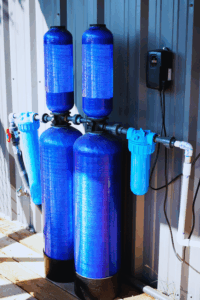 An undersized water softening system causes problems quickly.
- Frequent regeneration cycles
- Hard water breakthrough
- Higher water and salt usage
- Shortened resin bead lifespan
- Spotting, scale buildup, and soap inefficiency
If your system regenerates every day or two, it is likely undersized.
What Happens If Your Water Softener Is Too Large?
Oversizing creates different issues.
- Resin fouling from infrequent regeneration
- Inefficient cleaning cycles
- Wasted water and salt
- Higher upfront cost
- Water sitting too long inside the tank
Stagnant water inside oversized systems can reduce efficiency and create maintenance issues.
Other Factors That Affect Water Softener Size
Beyond hardness and number of people, several other variables affect sizing.
Iron in the Water
Iron increases strain on resin beads. Even small amounts require grain adjustments. Homes with iron-heavy well water often need larger systems or additional water treatment equipment.
Flow Rate and Peak Demand
If multiple showers run at once, the system must handle peak flow. Large families or homes with many bathrooms may need a larger water unit. This helps keep good pressure and steady soft water delivery.
Well Water vs City Water
Well water often contains sediment, iron, and manganese. These minerals stress smaller systems. City water typically has consistent hardness levels but should still be tested.
Well homes often need larger grain capacity systems or pre-filtration to protect resin beads.
Should You Size Up “Just in Case”?
A small buffer makes sense. A dramatic oversize does not.
Sizing up slightly can reduce regeneration frequency. Oversizing significantly can create inefficient cycles and waste water and salt.
The best approach is to calculate grains per day accurately and consult a professional for confirmation.
Professional Water Testing vs DIY Kits
A DIY test kit provides a quick snapshot of your water hardness level. It may not detect iron or other dissolved solids accurately.
Professional water testing measures full mineral content, checks flow rate, and evaluates your daily water usage. It also confirms whether a salt free water softener or traditional salt-based water softening system is appropriate.
Exact GPG matters. A difference of just a few grains per gallon can shift recommended grain capacity by thousands of grains per week.
Frequently Asked Questions
What size water softener do I need for a family of 4?
Most four-person households need between 32,000 and 48,000 grains.
The exact size depends on water hardness level and daily water usage. If hardness exceeds 12 GPG or iron is present, lean toward 48,000 grains.
Always calculate grains per day before selecting a unit.
Is a 48,000 grain water softener too big?
A 48,000 grain system is not too big for most medium to large households.
For smaller homes with low water hardness, it may be oversized. If regeneration cycles extend beyond two weeks, the system may be larger than necessary.
How do I know my water hardness level?
Use a city water report, a home test kit, or professional testing.
Professional testing provides the most accurate grains per gallon (GPG) measurement and checks for iron.
How often should a water softener regenerate?
Ideally, a properly sized water softening system regenerates about once per week.
Daily regeneration signals undersizing. Regeneration less than once every two weeks may indicate oversizing.
Can a water softener be too large?
Yes. Oversized systems can cause inefficient regeneration cycles and resin fouling.
Properly sized water systems operate consistently and efficiently.
Get the Right Size Water Softener Installed
 Choosing the right size softener requires accurate testing, precise calculations, and proper installation. Guessing can lead to wasted water and salt, poor performance, and unnecessary expense.
At Apollo Plumbing, we test your water, calculate your exact grains per day, evaluate iron levels, and install a correctly sized water softening system built for long-term efficiency.
When you want accurate water testing, proper sizing, and installation done right the first time, Apollo Plumbing is ready to help. We take the guesswork out of choosing the right system for your home.
Call today and speak with Your personal plumber.